


Hi everyone.
In my last post, I introduced the notion of a spell that has been cast in modernity (well, before, really, but it’s very visible now) and how women have been the most affected by it. Mostly unconsciously.
Before we go deep into the weeds of the spell and how it interacts with us all, I thought I could introduce you to our master spell-breaker. Because, quite frankly, with the speed of change these days, we need a master spell-breaker.
She is… a we, not an I. SHE is “the Matriarch.” Capital “M” Matriarch.
Let me introduce you to HER slowly. Before our minds fill in the blanks with assumptions and projections.
I’m curious. What happens for you when you hear the word matriarch?
(This is an actual question! :-))
Do images of domination, rigidity, or outdated hierarchies rush in? Or is there a quiet dismissal? A subtle judgement?
If so, it’s not surprising. The Matriarch has long been poorly understood.
Part of that misunderstanding comes from trying to make her into a personality, a role, or an identity, something an older woman simply is, rather than something a culture must bring forth.
But the Matriarch was never meant to be a type of woman. Not as I see it.
She was a function.
For most of human history, cultures relied on people who were not primarily organisers, warriors, innovators, or producers, but timers.
These people, often an older women, were attuned to “right timing.”
She would know, in her body, when something had ripened and was ready to be born. She knew when something was being pushed too soon, trying to make its way into the world prematurely.
She knew when a threshold was near. She did not force it into being. In this, she was like the rainmaker - not actually making the rain happen - but listening for the subtle shift in the air that meant it was already on its way.
To sense when it is time to birth, to stop, to harvest, or to let something die is no small capacity. It is embodied morality, a responsiveness calibrated to the rhythm of life itself. A way of aligning action with the season of things.
In modernity, these capacities have mostly gone underground. Without this attunement, we don’t know when to act, when to wait, when to “weed” around promising new ideas and when to let outdated ones die.
This capacity, or let’s call it a sense organ, isn’t mystical. It is ecological.
It is the natural consequence of living inside cycles long enough to recognise their innate pattern of birth, growth, harvest, decay, death, and return. Repetition trains embodied attunement and discernment.
This is not simply a thought. It is also a thought, but one that feels like whole-body knowing.
In tribal times, this was, of course, done largely unconsciously. Rituals were performed as whole-body prayers for what was being born: a baby, a marriage, a young woman or man crossing into adulthood.
Rituals were not arbitrary; they were deeply connected to what was emerging and what had come before. They held the past while directing energy and collective attention toward the future. Rituals and rites guided the tribe’s behaviour around births, harvests, and deaths.
Older women, the matriarchs, were shaped into this role because cyclical embodiment, over time, cultivated a different relationship to time and timing, and a deep attunement to what the next moment required.
The Matriarch did not lead through force, like male leaders often did. She regulated the collective through timing, setting boundaries, and holding perspective.
It’s important to be clear here:
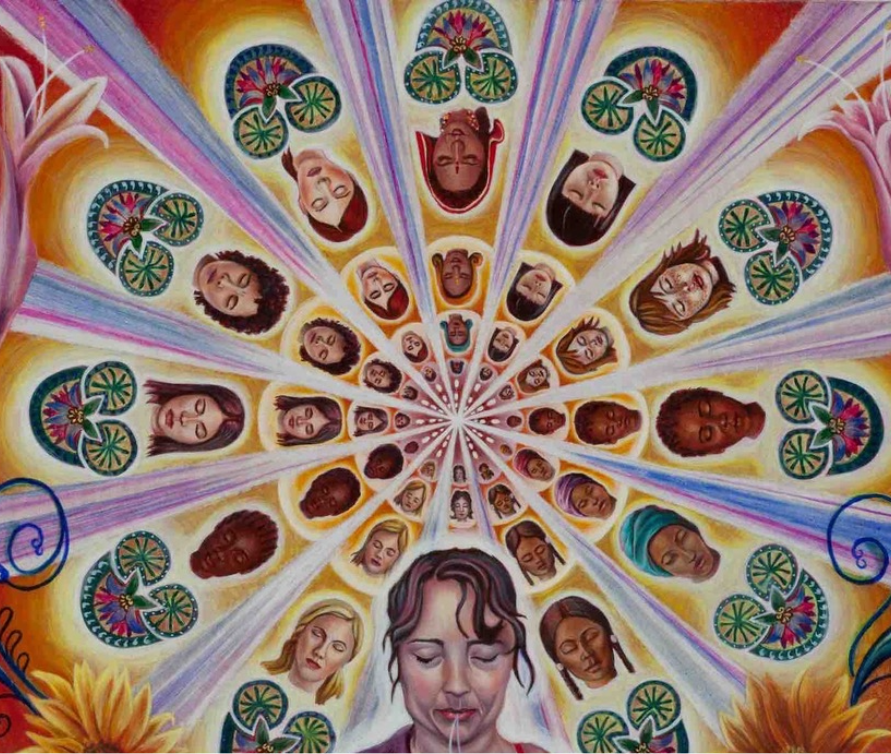
The matriarch is not simply an older woman, nor is she available at any age. The capital “M” “Matriarch” is a collective of “matriarchs”.
Let’s go slowly.
The matriarch, as an individual, is born through the rite of passage of menopause.
Menopause is not merely the cessation of bleeding. It is a profound neurological and hormonal reorganisation in which new neural pathways form. A woman’s hormonal life fundamentally changes as she moves out of the monthly oscillation that shaped her earlier decades.
This matters.
Freed from cyclical fluctuations, she develops a different relationship with time, urgency, and emotion. She is no longer pulled into the tides in the same way. This places her biologically and perceptually in a unique position.
Not above life, but outside the cycle she once lived inside.
This is what allows her to see patterns rather than live at the mercy of the tides.
But menopause alone does not make a matriarch.
It is a rite of passage, and like all rites of passage, it has two halves.
The first half happens in the body and psyche: the hormonal shift, the neurological rewiring, the psychological reckoning, the letting go of identities that no longer fit.
The second half must happen in relationship.
For the matriarch to fully arrive, she must be received.
She must be seen by others as having crossed a threshold. Evoked into a new role. Reflected back not as a woman who has lost something, but as a woman who now carries a different kind of authority.
Without this reception, the transition can stall.
And in modernity, sadly, it often does.
What we often see on the other side of menopause is that the modern woman may feel invisible rather than initiated, insecure about ageing rather than excited for what is emerging, reactive rather than spacious.
This is not because she has failed, but because no one can complete a rite of passage alone.
The picture is even more sobering.
Modernity makes it almost impossible for a mature woman to see herself as going through a rite of passage when approaching menopause. In fact, it constantly offers her “ways out,” as if the rite of passage itself were a meaningless nuisance that should be avoided or managed away.
The bodily changes one might expect to naturally occur are often prevented by modern interventions. HRT (hormone replacement therapy), for example, is designed to give back to the body what the body is naturally weaning from.
For me, it is less about the action itself and more about the type of mind that creates “perceived” solutions in the first place. What kind of mind would see menopause simply as diminishment? What kind of mind creates breastfeeding schedules? Or a planned caesarean?
At this point in the article, it is important that I say that, whereas I can be provocative in my thinking, I hold no personal judgment of each individual’s choice. Truly. There is simply compassion for us all surviving modernity in the best way we know how.
But back to the provocations… ;-)
What I see is a culture obsessed with productivity that has little patience for women who no longer produce in the same way. A culture fixated on youth that does not know what to do with women whose power has changed shape rather than diminished.
This mindset, so normalised by modernity’s standards, is a major consequence of the Spell we spoke of in the last article.
In this context, even if women are able to move naturally through the rite of passage of menopause, many emerge biologically transformed but culturally orphaned. There are no communal markers, no shared language, no collective pause that says: something has changed, and it deeply matters, for her and for us all.
We are left with words that describe aspects of our transformation through the lens of lack and pathology. And with these words, we create culture.
Brain fog, mental fatigue, tiredness, reduced focus, moodiness, anxiety, hot flashes, etc. (We’ll explore this more deeply in future articles.)
And so we, modern women, arrive as elders from broken lineages, perpetuated by the spell.
When this negative and extremely myopic framing of a rite of passage happens at scale, the matriarch, and all the capacities she could hold, remain latent in her and in culture. In our times, they have gone so deeply underground that they have mostly disappeared from our collective consciousness.
Unlike what happens in many indigenous cultures, the modern matriarch may feel her acquired wisdom has no seat. That her perspective has no mirror. That her authority has no cultural legitimacy.
What remains is often insecurity and frustration, personal, relational, generational, when what is actually missing is recognition. Even from herself.
In cultures with well-defined roles, rites, and recognition, the matriarch would be a natural evolution of a woman’s life. She would embody a role she is recognised for. In modernity, as we’ve seen, it does not work this way.
What happens then when we have partially initiated elders and a culture that desperately needs guidance?
This is when the Matriarch (capital “M”) as a collective force is born.
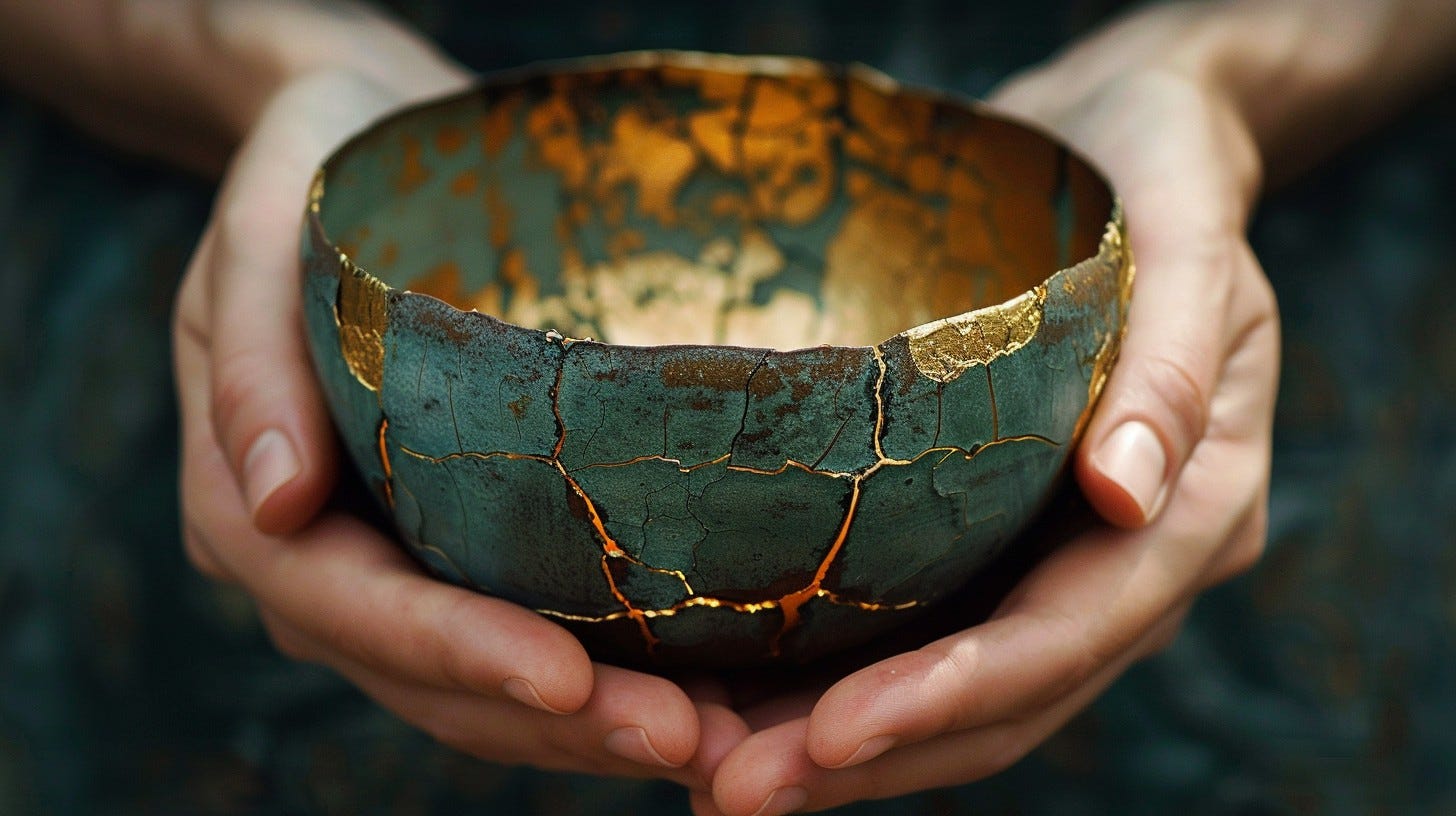
Kintsugi, the art of repairing broken pottery with gold, offers a living metaphor for this collective emergence. She is not one perfected woman standing whole and intact. Each of us carries gifts, and each of us carries fractures - distortions shaped by modernity’s spell. On our own, we may feel immobilised by the cracks. We may feel insufficient or “useless” in a culture that values seamless productivity. I know I’ve felt like that many times.
It is when we come into right relationship with one another that something different happens.
SHE arrives.The Matriarch.
In HER, what was fragmented becomes patterned. The spell that cracked us as individuals has not broken the whole.
The Matriarch is the new vessel born between us, not despite the cracks, but because of them. She is most visible where the fractures once were and where, through connection, gold now runs.
SHE, the master spell-breaker, matches the depth of our forgetfulness in vastness and power.
This is precisely the intelligence our times require. It is HER who will redirect energy when it’s too much, who will remind us what we should be giving birth to, and what we should value.
If you haven’t guessed, it’s not just power and money.
The good news is: SHE is back. In collectives, you’ll find HER.
Have you already found HER? Let us know.
Stay tuned… more to come. We are just starting our spell-breaking journey. :-)
Once again, you don’t need to agree with what you’ve read. Simply notice how it landed.
Did you feel recognised, unsettled, sceptical, relieved, or unexpectedly emotional?
None of those responses is a problem.
They are information.
Spell-breaking information.
Yes! "biologically transformed but culturally orphaned" - I feel this deeply. I'm starting to discuss in the women in my community what a rite of passage would look like for me to enter into this phase of my life. I reach the arbitrary 1 year mark of no period in June of this year. When my friend suggested a ritual of community to welcome me into this phase, I cried. Your framework is giving me so much more mental scaffolding that I felt in my body but didn't have a way to communicate. Thank you so much Adriana. FYI - here's a podcast that I recorded over a year ago when during a mushroom journey I sensed I was coming up on this transition (I didn't realize, of course, HOW close to menopause I was, lol!) https://open.spotify.com/episode/4n0uBeiEjCALOvqdydCgfK
So beautiful, Adriana! Every single word you write touches me deeply and resonates with my lived experience.