


The way Asha Rose, my second child, was dreamt into existence was only made possible from the vantage point of the woman I had become through Luana’s gestation and birth.
More confident and deeply connected to the mystery of bringing Heaven to Earth, I was ready for a journey into trust like never before.
There is one thing you need to know about me. Like all babies, I was born into this world a mystic and retained my magic, against all odds, for longer than usual in my family context.
As a young child, I’d spend hours writing letters to what I imagined was a magical creature named Santa. But no matter how hard I tried, I couldn’t understand why I was supposed to ask him for material gifts. Instead, I’d gaze at the night sky, captivated by the shimmering stars, and wish for something truly magical—a personal relationship with one of them. When my mum gently pointed out that this might not be the most practical gift, I’d reply with, “Well then, how about just a little bit of stardust?”
As you know, our modern world is not a nurturing environment for a young female mystic. Growing up with mechanistic values slowly crushed my soul, and little by little, most of my magical outlook on life was extracted from me as I became a reflection of our functional, sanitised, and barren constructs.
The experience I am about to share was puzzling and weird, in the most magical way, even for someone as open to magic as I had been.
Back to the story…
(The following pages are an excerpt from my book. This first part begins with me at a cabin, surrounded by other women, most with their babies. We held space for other women from the group who had ventured into the forest for a Vision Quest—a three-day, three-night journey of introspection and connection with nature. I didn’t join the Quest then, as I was still breastfeeding my one-and-a-half-year-old.)
…A friend offered to hold Luana inside the cabin so I could drum for a few hours on the beautiful hill close to the house. As I was drumming—which we already know brings altered states of consciousness—I heard this voice saying, “Get ready, I am coming.”
Yes. This is what I heard, and before you ask, no, it wasn’t just a thought. It was different. It was a loud and clear voice. Maybe on the inside. Maybe on the outside. I couldn’t tell. But it wasn’t anything like what I understood as thoughts.
Let me just say that from this point on, there is nothing very conventional about Asha’s conception, pregnancy, and birth. If Luana’s gestation and birth had been focused on “the “undoing of modernity”, my journey with Asha welcomed me back into the Mystery.
This first experience was, as you can imagine, quite puzzling, and I knew I couldn’t share that with others as it would put me in the “new agey” and “ungrounded” category quite quickly. How could I be honest whilst also retaining some sort of credibility with pure rationalists like most of the males in my family? Should I even care?
I had been used to “squishing” my mystic self into a more vanilla, flatland (as Ken Wilber would say) version of myself my entire life, so I did just that.
What wasn’t apparent to me, however, was how, by doing so, I was preventing others from also freeing themselves to share more openly all the experiences that didn’t fit into the boring constructs we try to accommodate our lives into.
I’ll start by saying that nothing about Asha’s birth fits into what the medical system told me about conception, pregnancy and childbirth. I’ll also add that the woman I was when living in Brazil many years before getting pregnant would never have opened herself up to his experience. I was very much in my head, readily classifying life, and there was little space for magic.
I rarely shared Asha’s birth story in details as I feared being judged as “too woo,” so I kept elements of the journey close to my heart.
After that first encounter at a mountain top with a voice telling me to prepare myself, I went on to quickly explain away that experience by telling myself it was just the drumming, or just a louder type of inner dialogue, or…
Even though the drumming certainly catalysed it, and yes, it was, in a way, an inner voice that shouldn’t render the experience insignificant. Even if that was my subconscious speaking, it was interesting to find out, through the voice, that a baby was on its way (or that a part of me intended it to be on its way).
I should prepare, I thought.
A few weeks later, I went to another weekend gathering with the same group of women. That time, I was learning how to facilitate the “shamanic journey of pregnancy,” the same workshop that had introduced me to all this new wisdom during my pregnancy with Luana a few years prior.
In that workshop, again, guided by the beat of the drum, lying on the floor with my hands in my womb, I was encouraged to sense into my womb space. As soon as I gave in to the beat of the drum and the chain of thoughts stopped, the familiar voice I had heard at the top of the mountain startled me once again. But this time it said: I’m here.
I was ovulating so I knew, for a fact, that here here, inside of me in a physical sense, the voice wasn’t. But again, I WAS ovulating so I suppose this could be seen as a “cue” from my womb??
Now I had two interesting things happening and both pointing me in the same direction. I had the persuasive voice coming from my womb (yes, I know how weird this sounds) AND my ovulation, so I could either play deaf, try the Virgin Mary approach, or have a chat with my partner about…conceiving a baby.
I chose the latter.
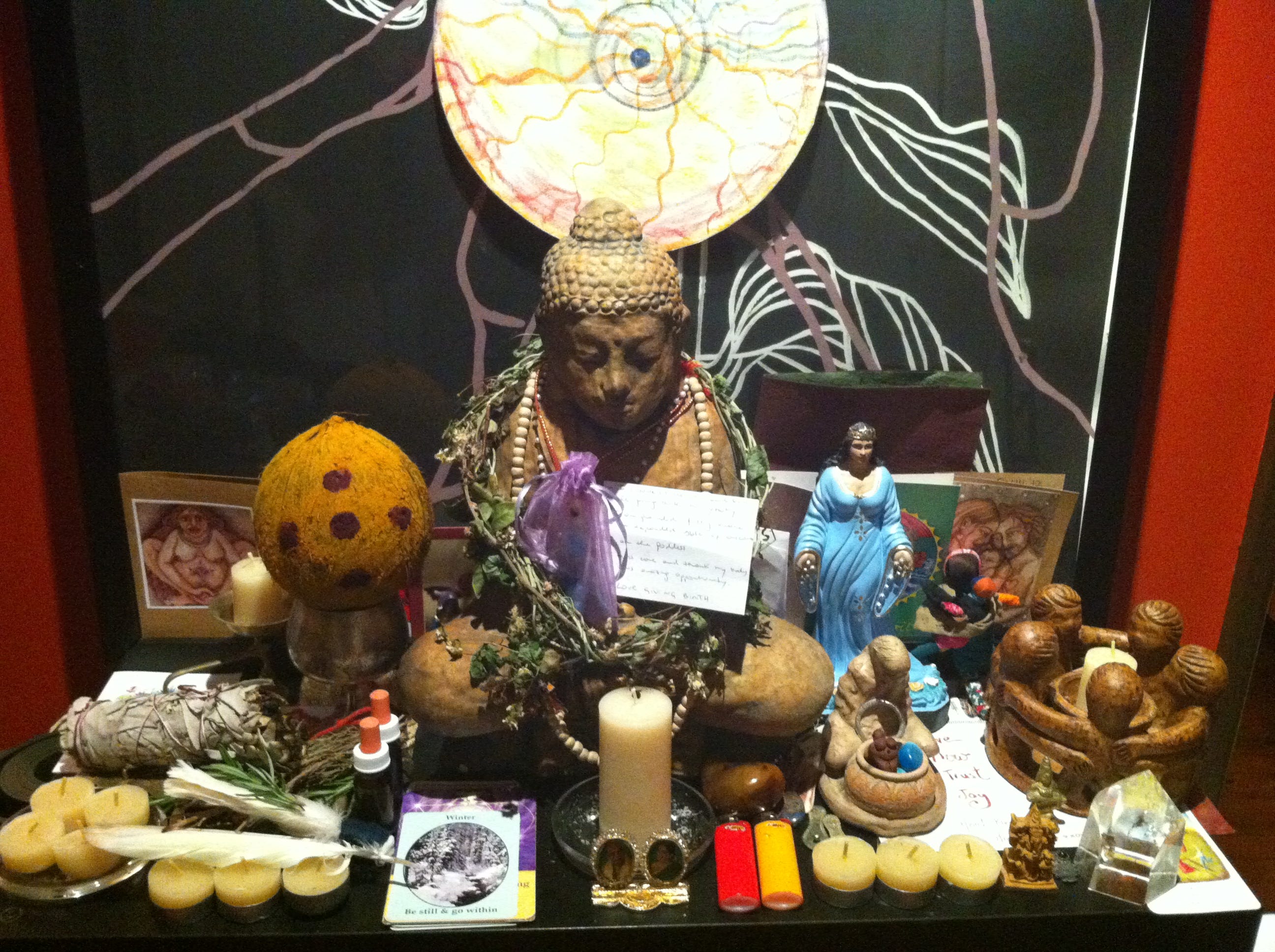
Before sex, still partially sceptical, I went to my altar (yep, I had an altar!) and said casually, as if asking a friend to give a message to a person I am less familiar with: “Hey, someone in the spirit world, if this “womb voice” wants to make its way here it better take the chance I am about to give.”
I like playing cynical, but I knew the baby would be conceived that night.
It wasn’t something that I was thinking about but something I had become attuned to, like a rainmaker who attunes to when rain is already on its way and people believe he made it happen. I knew I was already not alone in “my field.” In the same way that the changes in air and in the surroundings allow the rainmaker to read that particular phenomenon as “rain is coming,” I also knew my baby was coming.
Sex was extra good imagining that we could be conceiving a baby consciously in that very moment. Wow, imagine that. I was becoming a witch.
The following week, I was pretty radiant. I had a confident bounce on my step—the step of someone who knows.
I bought the pregnancy test, but it barely felt necessary. I knew I was pregnant. I had come a long way from doubting the voice in my belly to fully embracing the weirdness of it all. I was starting to embrace the wondrous and mystical ride I seemed to be on. Until…
…a single line on my pregnancy test crushed my dreams of having become a full-blown mystic.
What was I thinking? That “the voice” in my womb meant that an unborn baby, existing in some rarefied realm that I couldn’t see, was communicating with me? This idea had grabbed me so much that I believed I was feeling something.
Well, I was feeling something.
But if the test said no, it must be true. The test would know better. The outside world seems to always “know” better.
Oh, wait! What about Luana’s pregnancy and birth? Did that journey not teach me anything? Couldn’t the outside world be wrong and my internal sensibilities be right?
That initial thought worked as a green light to a different thinking pattern. A timid voice, this time my own, spoke in whispers, and it said something like, " Maybe, just maybe, the test is wrong, and you are right.” Could that be possible?
The short answer is yes. It was possible, and yes, I was right.
A few weeks later, I got a new test, and the two lines came on strongly this time. I had been right all along.
I was a rain-maker of babies, whatever that meant.
My body could feel subtle changes, and I was stoked that the undoing I had started during Luana’s pregnancy and birth was being deepened by this new baby - the womb whisperer.
If Luana’s pregnancy and birth initiated me into trusting my wilder nature, Asha’s conception, pregnancy, and birth had a very different quality. Asha (or the baby with no name at that point) invited me into the journey of a wild, magical and fearless woman.
In my first pregnancy, I was a modern-day woman aspiring to re-wild myself, and for that woman, giving birth at the birth centre was the perfect compromise. It pushed me enough to shift my patterns, but it didn’t aggravate my nervous system to the point that I wouldn’t feel safe.
Three years felt like another incarnation. By the time I had conceived Asha, I was no longer the same woman who had conceived Luana. I had sat with other women for hundreds of hours; I had birthed without any intervention, and through that, my body re-membered.
I had seen my mum’s healing as she saw, through me, how birth could be done when a woman surrounds herself with people that she trusts and who trust her body’s birthing capacities. I had breastfed for almost three years, I had co-slept with my kid and carried her around on my body. I learned how to read her fevers, her cries and her mood. I learned how to trust myself as a wise woman.
This new me didn’t feel new at all. It felt like a much truer me that an avatar had co-opted until then. I was awake and more present than ever before.
Asha’s “magical” conception gave me the trust to push this journey to a new level.
I had heard of women who birthed on their own; it’s called “free birthing” and, at some point in our history, was probably natural, but I knew that was a bit too much for me.
Knowing my limits felt important. So, I chose a homebirth midwife with the intention of not going to the hospital unless it felt necessary. It was important to me that I didn’t delude myself with wishful thinking and that I embraced the magic of life in a way that included my partner’s feelings, fears and judgements.
The pregnancy made evident both the beauty and depth available to pregnant women and also the chasm between what my body needed and what the modern world imagines pregnant women should have.
Amidst all the stressors of modern living, I still had a great pregnancy. My midwife was very wise and had supported hundreds of women through the birthing process. She called herself a birth Maya, someone who worked unofficially as a homebirth midwife. It was perfect for me.
She embodied the wisdom I was longing for. My “exams” were done the old way, with no ultrasound machines or fancy equipment. She’d come home; we’d have some tea together and chat. She’d listen to the baby's heartbeat, and that would be it. During the whole nine months, I didn’t set foot in the hospital. There was no need.
Sheila became extremely important to me at the very end of my pregnancy. In conventional medicine, it’s common knowledge that if a pregnancy goes for longer than 42 weeks, the mother should be induced.
From a medical perspective, many things can “go wrong” with pregnancy, and such things determine if you should or should not give birth naturally. A pregnancy that goes over the 42-week mark is considered post-term, and the recommendation of the medical system is induction. Induction means that pitocin, a synthetic version of the naturally occurring oxytocin, is given intravenously to the birthing mother to initiate contraction.
I won’t go too deep into this as, at a later point in the book, we’ll explore the various ways in which one category of thinking steps in to “fix” or address an issue that belongs to an entirely different category of experience. I am using conceptual confusion to speak about such instances and interventions in birth that would fit into this category. I'll just say, for now, that measuring a birthing mother’s cervix and talking to her about her dilations as if she was on a mission to “improve her time at a running race” is undoubtedly the wrong method.
The same way that measuring a woman’s vaginal excretion during sex and talking to her about it would kill the excitement. The medical system’s approach to birthing mothers is the equivalent of that. Nothing closes a woman’s cervix quicker than someone she doesn't trust wanting to measure it. Who would even think this was a good idea?
The fact that we think those approaches are what the situation requires is what I call conceptual confusion. I'll discuss this further later.
At 42 weeks of gestation, all I knew was that I couldn’t trust the medical model to honour the rhythm my baby and my body had been dancing to. It could not attune to this sacred rhythm. So, for the sake of my health and the health of my baby, I didn’t want to be induced.
(heartwarming to find this yesterday as I was looking for images for this post. This video was done exactly 11 years ago! Asha turns 11 tomorrow! A younger me, super swollen, ready to pop, expressing some of the insecurities that were arising and the challenges of having my pregnancy being “measured” by a system that doesn’t understand the “Kairos/Kainos” timing of birth. Chronos is NOT the right way to measure a woman’s pregnancy.)
My midwife was attuned to the magic and rhythmicity of the female body. She would tell me, amidst laughter, “I’ve never seen a baby not come out.” Sheila also shared that she and her sisters had all been born “post-term,” and there was nothing unnatural about it.
Through our conversations, it became evident to me that the “right timing” that people used to refer to as the boundaries of a “healthy and “normal” pregnancy was a construct that did women less good than it was commonly understood. Hearing her talk so naturally about what doctors called “post-term” relaxed my nervous system.
Her words sounded like truth to my body. I could feel it.
There was nothing in me that felt like I was putting my baby or myself at risk by wishing to allow the timing of birth to occur naturally, even if everyone else was mirroring something else.
My partner was a great ally. He had been a fantastic support at Luana’s birth, and he now respected all my choices despite some of them making him a bit uncomfortable.
Once the 42-week mark was reached, he started getting nervous. At that point, my mum had already arrived from Brazil, and the pressure was real. My aunt, a gynaecologist obstetrician, “in-formed” my mum of the risks I was potentially taking, and the energy around me tensed up like an overinflated balloon. As the pressure increased, so did my practice. By that time, I was a full-blown, unapologetic mystic, tuning to the sounds of nature, the pulse of my belly, and the signals that were still not visible. If a voice in the womb directed the onset of this pregnancy, I’d attune to the same voice to tell me when the time was up.
The voice didn’t speak the same way, but the knowing was even more straightforward. It was as if the voice had moved from the womb to my whole being, and instead of language, even if it was on my mind, it was now using a whole-body gestalt that felt like undeniable truth. I could trust that.
A few days later, in the middle of the night, I woke up with strong contractions. I remembered thinking it would be tricky “ to do 8 hours” of this. I was basing the estimation on the birth length of my previous experience, which lasted eight hours. What I didn’t know was that I was already in transition.
Thirty minutes later, my baby was in my arms.
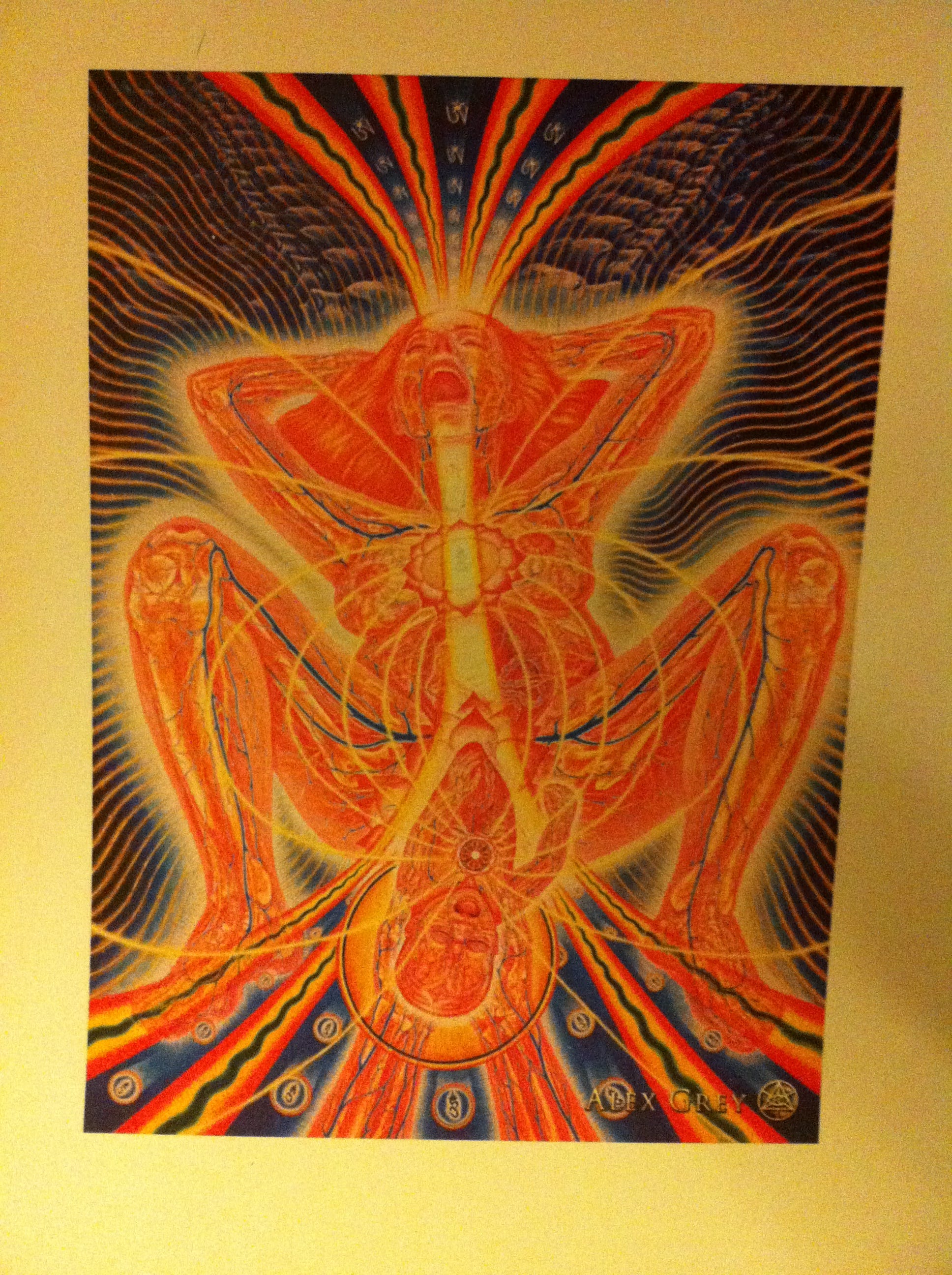
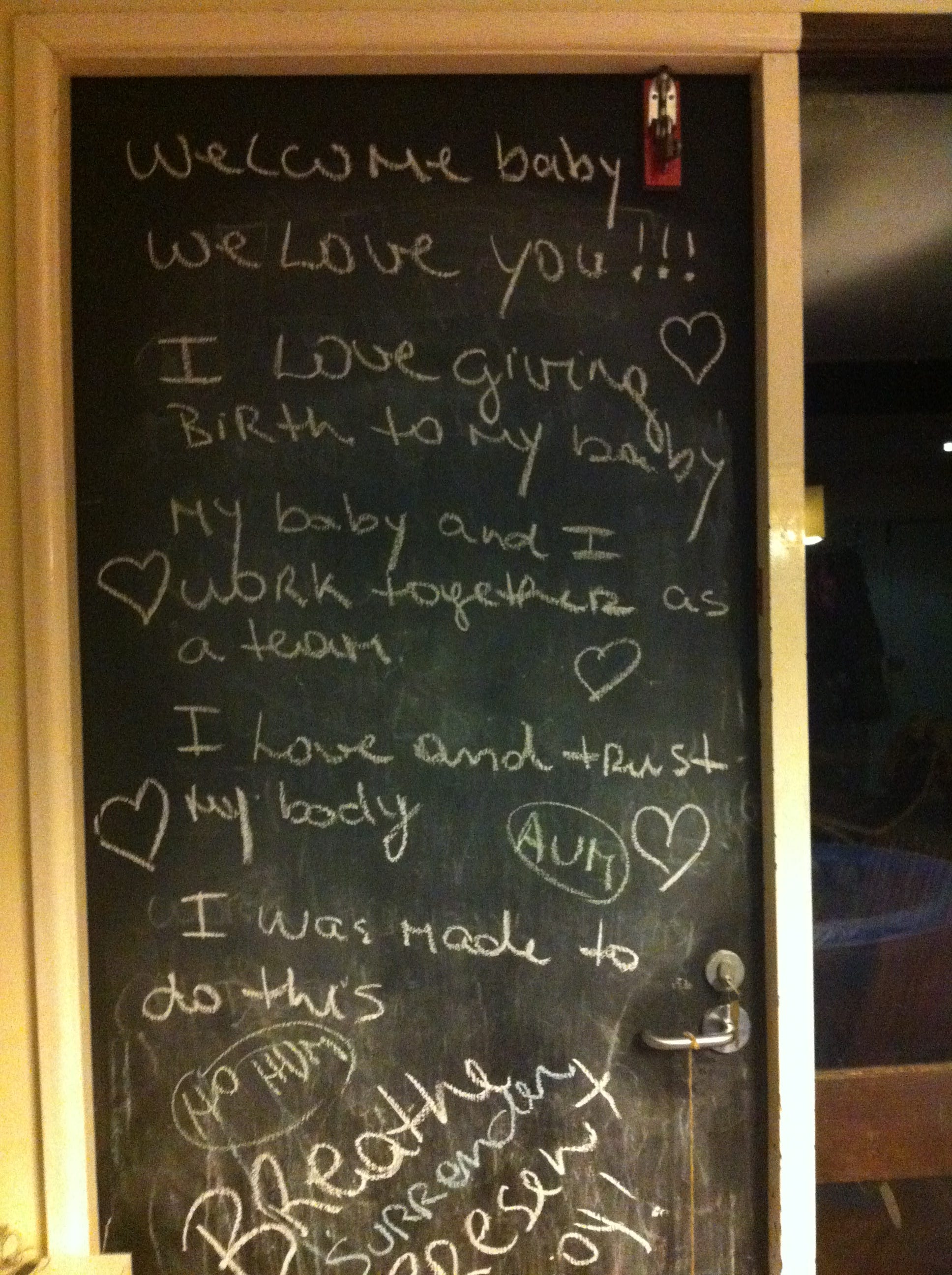
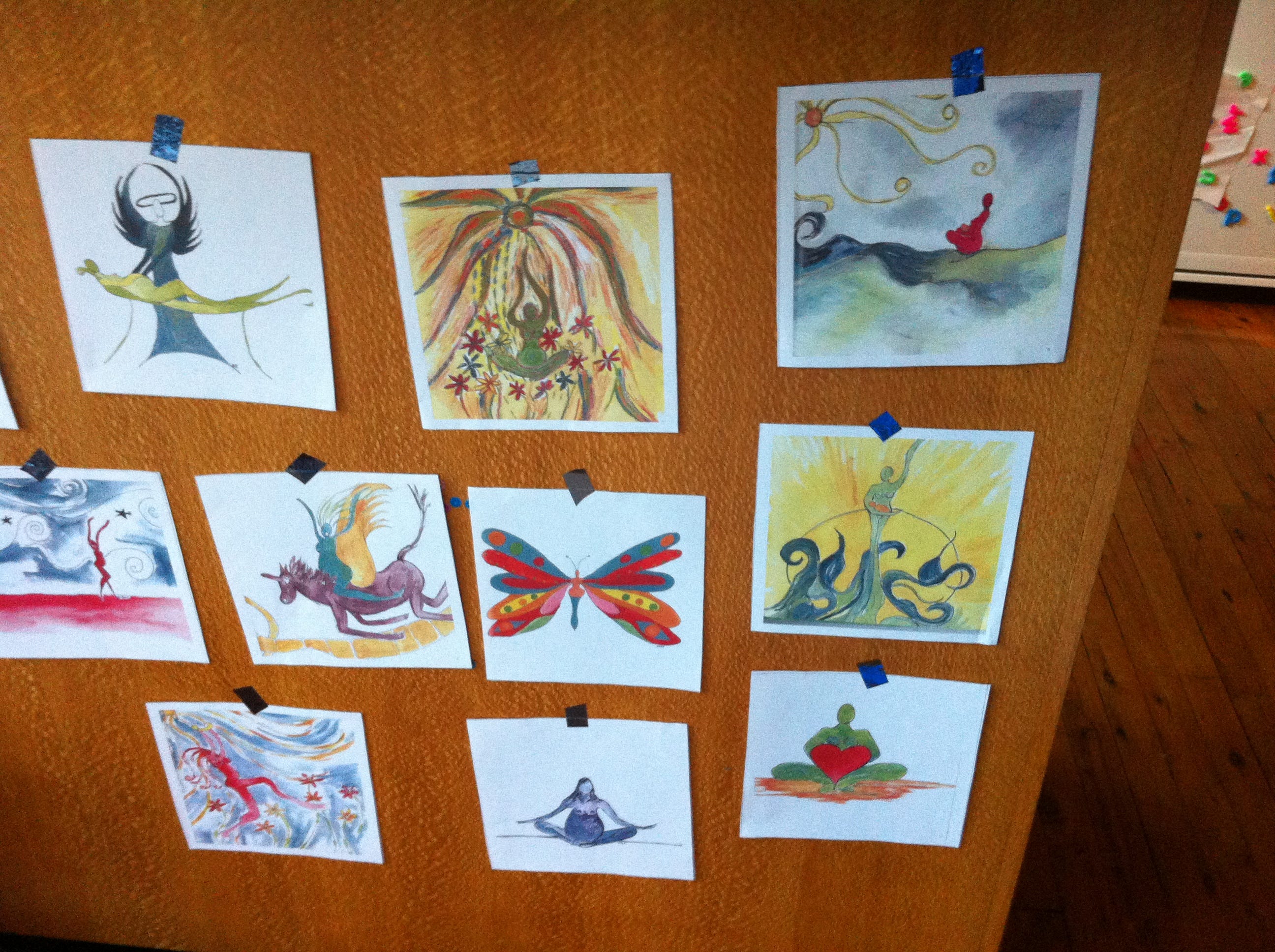
(images I glued all around the house and messages I wrote for the birth)
Sitting on a birthing stool dropped off by Sheila earlier that day, I birthed Asha before my altar. The midwife didn’t make it on time, which had secretly been my dream. I had the free birth I dared not wish for as I judged myself too “modern” for birthing like a wild woman. Yet, this is how it happened.
My partner acted like a ninja and put his testosterone to good use. His rugby reflexes also came in handy. In seconds, he had the floor covered in rags and newspaper (don’t ask me why!) and himself positioned in what turned out to be the perfect place. Asha shot into his arms a few moments later. My mum, once again, was my witness as I found the wildest and most free side of myself. As Asha came out, my arms lifted in an involuntary act of prayer, gratitude and relief.
The big bang had just taken place inside of me. Potentiality was made actual.
At that moment, a shared recognition, validated by the meeting of our eyes, disclosed the new pathways of meaning that had been created. The sacred, which earlier in my life had been a concept, a wish, something that rested heavily on the idea of transcendence, permeated everything.
I now embodied the paradox of birth: As natural as brewing a good cup of tea and as extraordinary as climbing an impossible mountain. Ecstasy and pain had never fit so well together.
To this day, I can’t find one word to explain what it felt like to have that amount of energy coursing through my body. Natural birth was no longer a far-fetched aspiration or a concept in my head but my body's natural movement as it purged the baby from its insides. Something so simple and yet sadly estranged from our modern selves.
My heightened state, orchestrated by a sophisticated cascade of hormones, merged into an awakening experience that evoked love and a commitment to serve this beautiful planet and the baby that had just arrived. How could we, as a culture, have dismissed the massive nature of this rite of passage?
It saddens me to remember the amount of times I have heard harrowing birth stories followed by something like: what matters is that the baby is alive and well.
Whereas the baby's health and well-being are the desired outcomes of birth, facilitating an experience where women can have the initiation they are designed to have is equally important. Mothers and babies are, for an extended period of time, a single unit, and birthing confident and trusting mothers should also be the priority of our medical system.
My mum’s eyes once again met mine. We laughed and cried. She and I were redefining what was expected and healthy for a birthing woman. Together, once again, we were healing our lineage. The midwife arrived in time to catch my placenta. She cooked us breakfast as my oldest daughter swam in the unused birthing pool. It all felt sweet and joyous.
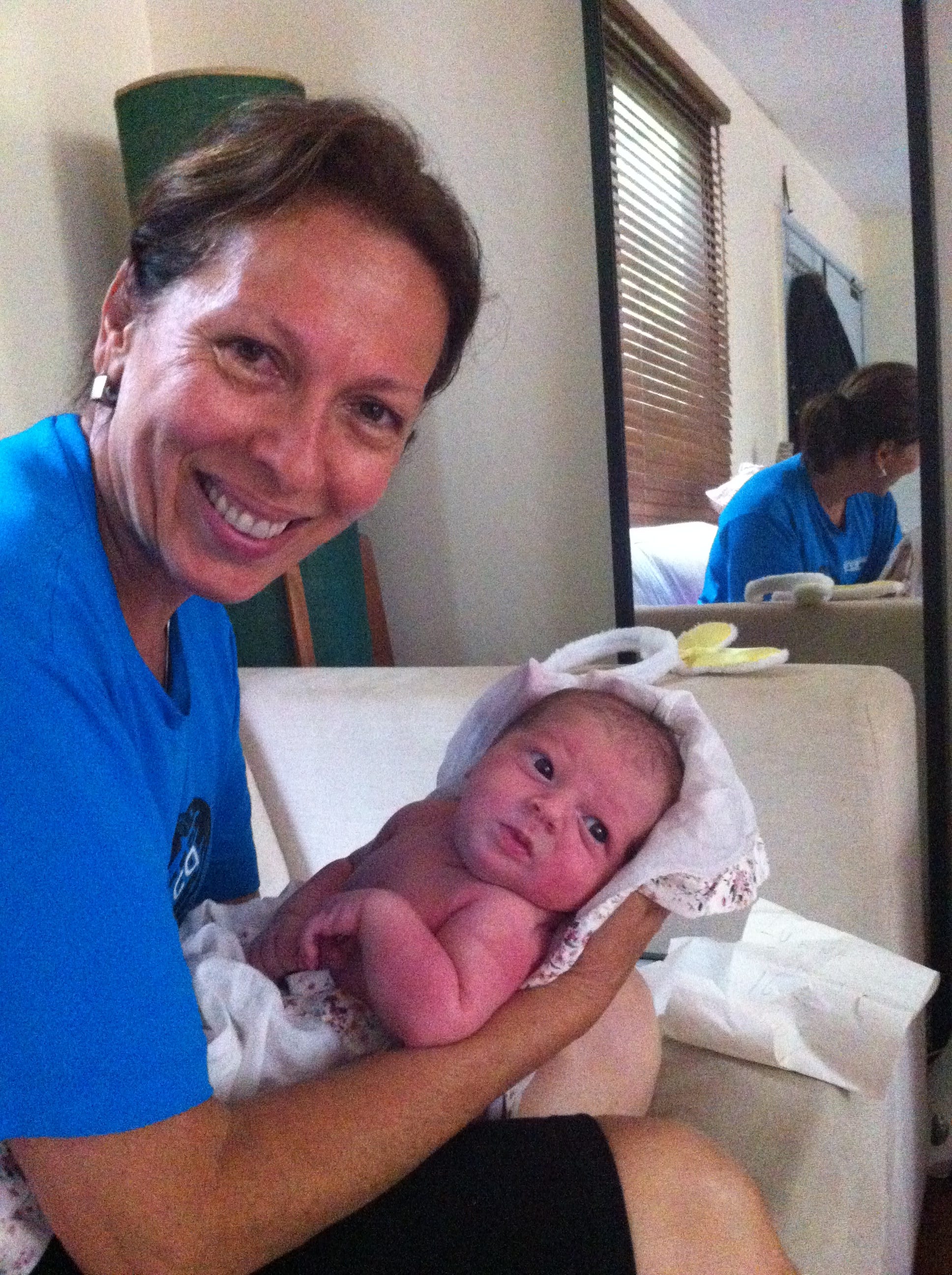
This time, I didn’t get stitches, and I could have the lotus birth I longed for. Something that I tried to do at the birthing centre, but it was a bit difficult in that setting.
I learned about “conscious conception” and “lotus birth” during my first pregnancy. Both captivated me, yet I knew it was too much to ask of my “modern-woman body”. I had some rewilding to do.
Asha, being born at home made it easy to entertain my desire to have a lotus birth. The idea behind it comes from various Indigenous cultures that recognise the placenta as the most significant physical and subtle companion and source of nutrition for the baby before birth. A lotus birth means leaving the umbilical cord attached to the baby and the placenta until the baby is ready to be free from it and fully come into the world. I saw it as an incredibly gentle approach to bringing a baby into the world. The placenta, while attached, would keep the pace and movement of mum and baby slow (it is physically more complex to move with a placenta attached to the baby). This slower pace would allow the baby to have a gentler transition into the outside world as if the placenta worked as the hallway, an entry point, to a larger place—the world.
I read various stories about lotus births, and they felt idyllic. However, I was also aware that they had the potential to be a disaster. No matter how much I enjoyed my rewilding journey, afforded by pregnancy and birth, my life was still relatively conventional. The idea of having not only a baby to care for but also a rotting organ (that should be salted and wrapped close to the baby) could be overwhelming.
My partner is a great guy. He is also an extremely pragmatic man, and even though he went with all I wanted to do during both my pregnancies, which felt right and honoured my budding wisdom, the rotting organ idea didn’t seem that appealing to him. So, I had an inner commitment to be flexible with my ideals. I’d try for a lotus birth, and if it got too difficult, I’d cut the cord.
In hindsight, a lotus birth was the perfect end for Asha’s entry into this world. Just like it felt like she initiated her journey into this world through the “voices in my womb,” it was also she who decided when she was fully ready to enter the world with her birth. At not even one day old, she pulled the cord.
Yep. It just got weirder.
I was breastfeeding Asha later the day she was born. It had not even been 24 hours since the birth. Her eyes gently shut. Her little hands brushed past her body and “pulled” the cord. As the cord snapped, her eyes opened, meeting mine. She was fully here.
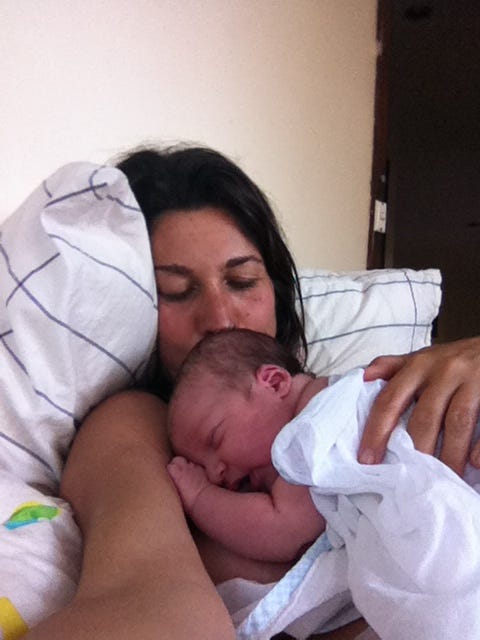
Over the years, I shared elements of this and other aspects of my pregnancy and birthing journey, always making sure I made the stories fit into the criteria of “credibility” constructed by our mechanistic view of the world. I had become accustomed to dumbing down my stories not to make them sound “too out there” or “too woo”. Recently, going through yet another rite, menopause, I am finally getting the courage to say there is nothing as mysterious and magical in this life as birth and death and “dumbing down women’s stories perpetuates the illusion that life is devoid of magic.
As the natural gatekeepers for such transitions, women are highly attuned to the “invisible.” Modernity has made us forget, but it’s time to remember…
This is the 3rd and final post on sharing birth stories. They are dedicated to my friend Cheryl, that is about to become a mum and to all the new mums that are also participating in our collective art-making.
Part 1 is here. Part 2 is here.
If this touched you in anyway, consider sharing C-Lab.